Non-invasive aerial surveys for forest cover mapping, wildlife population monitoring, encroachment detection, and biodiversity assessment — delivering critical ecological data with minimal disturbance to sensitive habitats.
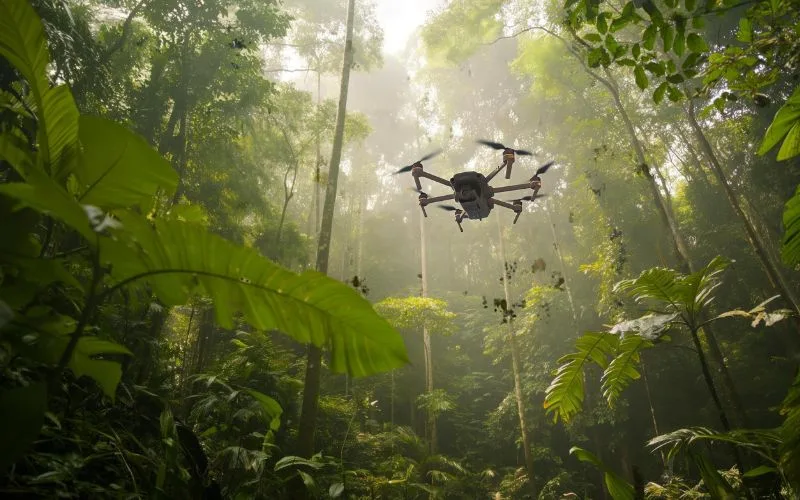
Traditional forest surveys require large field teams working in difficult terrain for weeks — disturbing wildlife, missing inaccessible areas, and delivering inconsistent data. Drone surveys cover vast forested areas quickly from above, with multispectral imaging for vegetation health, thermal sensors for nocturnal wildlife, and RGB for encroachment mapping — all with minimal ecological impact.
A drone survey covers 1,000+ hectares per day with consistent aerial perspective — replacing weeks of ground team surveys while accessing terrain that is physically impossible to reach on foot.
High-resolution land use/land cover classification for forest departments — dense forest, open forest, scrub, grassland, and degraded areas mapped with GIS-ready outputs.
Thermal and RGB drone surveys for wildlife census — elephant, deer, tiger, and bird population counts in protected areas with minimal disturbance to animals.
Multispectral drone imaging for NDVI, NDRE, and other vegetation indices — identifying stressed, diseased, or degraded forest areas for targeted intervention.
Regular aerial monitoring to detect forest encroachments, illegal tree felling, mining, and agricultural expansion into protected and reserved forest areas.
Pre-fire season fuel load and risk mapping, active fire monitoring support, and post-fire burn area damage assessment for forest departments.
Progress monitoring of plantation and afforestation projects — tree survival rates, canopy growth, and plantation coverage for CAMPA and compensatory afforestation compliance.
Wildlife sanctuary and national park surveys require forest department and Wildlife Crime Control Bureau permissions. We handle all regulatory filings for sensitive area operations.
RGB for mapping, multispectral for vegetation analysis, thermal for wildlife detection — sensor payload is chosen based on survey objectives.
Flights are conducted at altitudes minimising wildlife disturbance. Approach routes avoid nesting areas, and dawn/dusk operations are used for thermal wildlife surveys.
RGB imagery is processed for orthomosaics and 3D canopy models. Multispectral data is processed for NDVI, NDRE, and LULC classification maps.
Forest cover change analysis, encroachment delineation, and wildlife habitat mapping are performed using GIS tools on the processed datasets.
Comprehensive forest survey reports with GIS data, NDVI maps, species habitat maps, and change analysis delivered in FSI/WII compatible formats within 72 hours.
Share your forest area and objectives — get a custom quotation within 24 hours.